Safety signs are designed to communicate important information quickly and clearly. One of the most effective ways they do this is through colour coding.
In Australia, safety sign colours follow standardised meanings to ensure consistency across workplaces, public areas, and road environments. Understanding these colours helps improve safety, compliance, and response time in critical situations.
Why Safety Sign Colours Matter
Safety signs often need to be understood at a glance. Colours play a key role by instantly signalling the type of message being communicated.
They help:
- Identify hazards quickly
- Guide behaviour in high-risk environments
- Reduce confusion across different sites
- Improve compliance with safety standards
Using the correct colour ensures your signage is both effective and compliant.
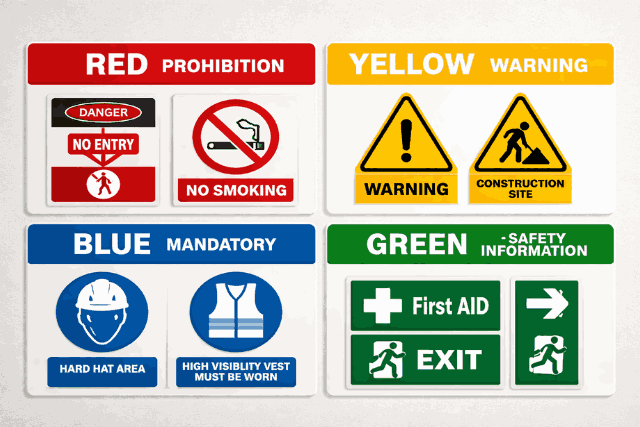
1. Red – Danger, Stop, and Prohibition
Red is one of the most attention-grabbing colours and is used to indicate serious hazards or actions that must not be taken.
Common uses:
- Danger signs – high-risk hazards
- Stop signs – immediate halt required
- Prohibition signs – actions that are not allowed (e.g. no entry, no smoking)
- Fire safety equipment signage
Red signals urgency and should always be taken seriously.
2. Yellow – Warning and Caution
Yellow is used to highlight potential hazards or situations that require caution.
Common uses:
- Warning signs – general hazards (e.g. slippery surface, uneven ground)
- Construction and work zone warnings
- Temporary hazard indicators
Yellow signs alert people to be aware and proceed carefully.
3. Blue – Mandatory Actions
Blue signs indicate actions that must be followed to ensure safety.
Common uses:
- Personal protective equipment (PPE) requirements (e.g. wear helmet, wear eye protection)
- Site rules and required behaviours
These signs are used to enforce safe practices in controlled environments.
4. Green – Safety Information and Emergency
Green is associated with safe conditions, emergency information, and directions to safety.
Common uses:
- Emergency exits and evacuation routes
- First aid stations
- Safety equipment locations
Green provides reassurance and guides people to safe areas.
5. Black and White – General Information
Black and white signs are typically used for general information or regulatory purposes.
Common uses:
- Traffic and parking instructions
- Directional signage
- General site information
These signs focus on clarity and readability rather than hazard communication.
Combining Colours for Clarity
Many safety signs combine colours to reinforce their message. For example:
- A red circle with a slash clearly indicates prohibition
- A yellow background with black symbols highlights warnings
- A green background with white symbols indicates safe conditions
This combination improves recognition and ensures messages are understood quickly.
Why Colour Compliance Is Important
Using incorrect colours can lead to confusion and increase safety risks.
Correct colour usage ensures:
- Consistency across different sites and industries
- Faster recognition and response
- Alignment with Australian safety standards
Proper signage helps create a safer and more organised environment.
Applications Across Different Environments
Safety sign colours are used across a wide range of environments, including:
- Construction and civil worksites
- Warehouses and industrial facilities
- Car parks and public spaces
- Offices and commercial buildings
Understanding colour meanings ensures signage is appropriate for each setting.
Conclusion
Safety sign colours are more than just visual design—they are a critical part of communication.
By understanding the meaning behind each colour, you can ensure your signage is:
- Clear and easy to understand
- Compliant with standards
- Effective in improving safety
Using the right colours helps create safer workplaces and public environments across Australia.
FAQs
What do safety sign colours mean in Australia?
Each colour represents a different type of message—red for danger, yellow for warnings, blue for mandatory actions, and green for safety information.
Are safety sign colours standardised?
Yes, they follow recognised standards to ensure consistency and clarity across different environments.
Can I use any colour for safety signs?
No, using incorrect colours can lead to confusion and may not meet compliance requirements.
Why is red used for danger signs?
Red is highly visible and universally associated with urgency and risk.
Explore Safety Signage Solutions with Civil Products WA
Looking for compliant safety signage?
Browse a wide range of warning, regulatory, and safety signs from Civil Products WA designed for visibility, durability, and performance across Australian conditions.
👉 Explore the range at:
🌐 https://www.civilproducts.com.au/